
May 26, 2026 · 11 min read
How Multilingual QR Menus Attract International Customers
Learn how a multilingual QR menu helps restaurants attract international customers with translated dish details, photos, allergens, and mobile-first access.
iMango Team
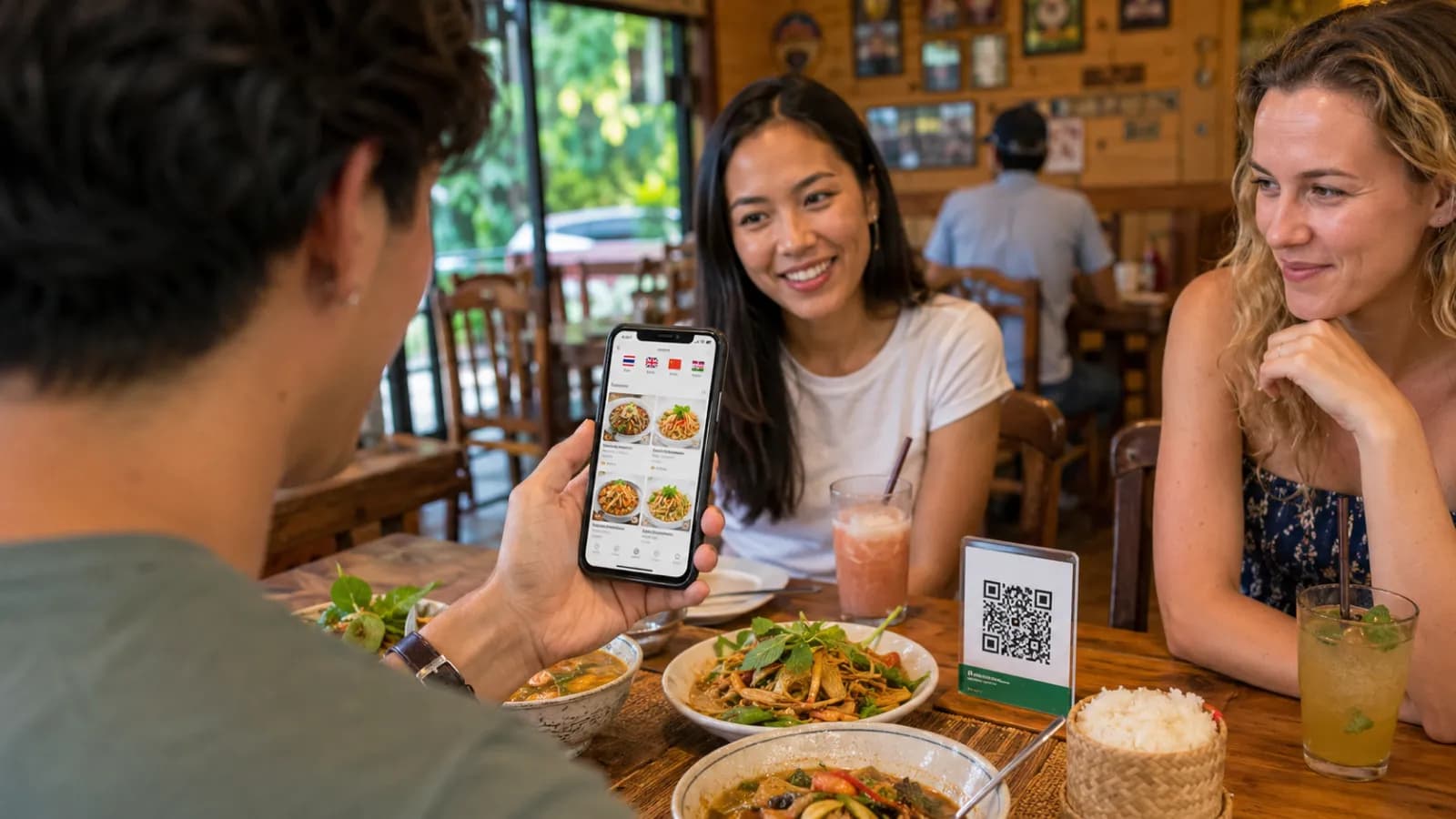
Short answer: a multilingual QR menu helps restaurants attract international customers by making the restaurant easier to choose before arrival and easier to trust once the guest is seated. When visitors can open a mobile menu, switch to a language they understand, see real food photos, check prices, read allergens, and understand local dishes without asking for help, the restaurant feels more accessible.
The QR code itself is not the attraction. The attraction is the signal behind it: "You can eat here comfortably, even if you do not speak our language."
That signal matters in tourist markets. Thailand welcomed 32.97 million international arrivals in 2025, and the Tourism Authority of Thailand recalibrated its 2026 outlook to roughly 30 to 34 million international arrivals. These visitors are not one audience. A restaurant in Bangkok, Phuket, Pattaya, Chiang Mai, Koh Samui, Krabi, or a hotel district may serve English-speaking travelers at lunch, Chinese families at dinner, Russian-speaking long-stay guests on weekends, and mixed-language groups every day.
A multilingual QR menu helps those guests say yes faster.
International customers often decide before they sit down
Many restaurants think the menu starts working when a guest is already at the table. For international customers, it often starts earlier.
A visitor may check the menu from:
- Google Maps;
- a hotel concierge recommendation;
- a social media bio link;
- a travel group chat;
- a review site;
- a QR code outside the restaurant;
- a photo sent by a friend.
If the menu is hard to read, only available as a blurry PDF, or written in one language, the guest may not complain. They may simply choose a different restaurant.
Consumer research supports this behavior. A Restaurant Dive report on an MGH survey found that 77% of diners checked restaurant websites before dining or ordering, and menu items were the biggest factor after visiting the website. Another industry report from Popmenu found that 80% of diners research menus online while comparing dishes, cost, and convenience.
Those surveys are not Thailand-specific, so they should not be treated as a direct forecast for one restaurant. But the behavior is familiar: people want to know what they can eat before they commit. International guests feel that need even more strongly because they are dealing with unfamiliar language, cuisine, location, and sometimes dietary risk.
A multilingual QR menu is a trust signal
A translated QR menu tells international customers that the restaurant has thought about them.
It does not need to look expensive. It needs to answer practical questions quickly.
| Customer question | What the QR menu should show |
|---|---|
| Can I understand the menu? | A clear language switcher and translated categories |
| Is this dish familiar or local? | Original dish name plus a plain description |
| What is inside it? | Main ingredients and cooking method |
| Is it spicy? | Spice level and whether it can be adjusted |
| Is it safe for my diet? | Allergen and dietary notes |
| What does it look like? | Real photos for signature and unfamiliar dishes |
| Is the price current? | Live prices that match the restaurant's actual menu |
| Can staff help if needed? | A menu that gives staff and guest the same reference point |
This is why a multilingual QR menu can attract customers before it increases any order value. It lowers the perceived effort of choosing your restaurant.
For a tourist choosing between two nearby places, the easier menu often wins.
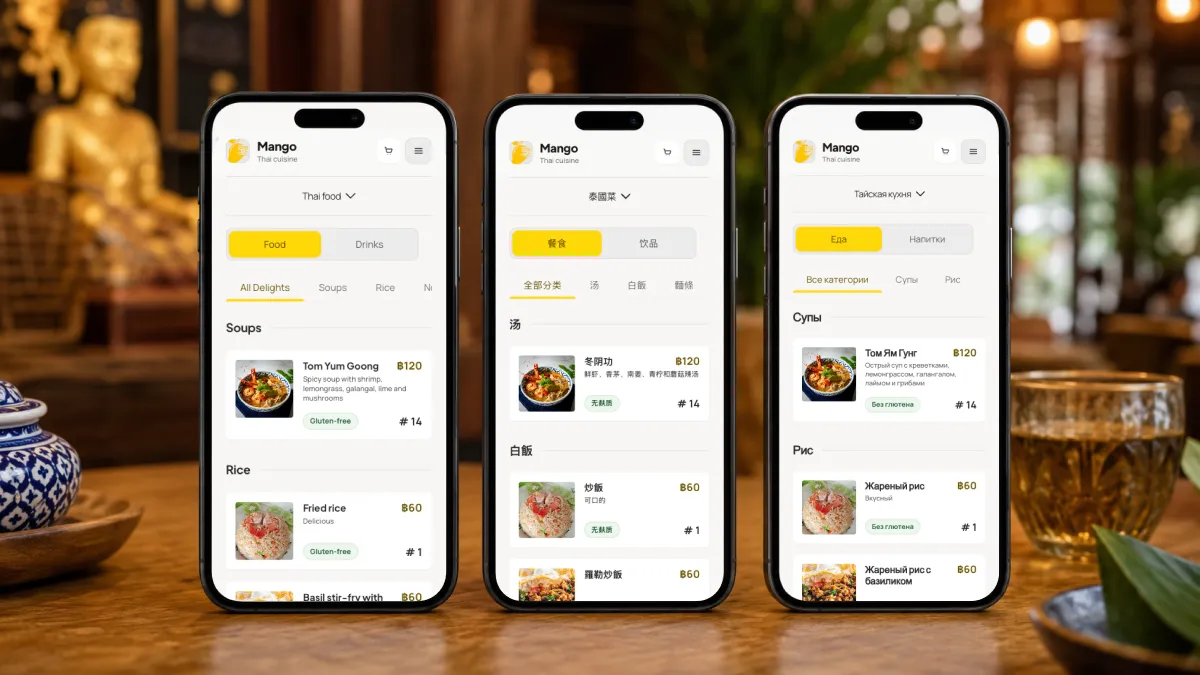
Choose languages from real guest demand
The wrong multilingual strategy is to add every language available in a tool. That creates maintenance work and low-quality translations.
Start with the languages that influence actual restaurant choice.
For restaurants in Thailand, a practical starting point is usually Thai and English. After that, the right language depends on location and guest mix. TAT reported 32.97 million international arrivals in 2025 and highlighted a value-led tourism direction for 2026. Its April 2026 outlook projected roughly 30 to 34 million international arrivals. That scale is large enough to make language support a real operating decision, but local evidence still matters more than national averages.
Use this decision table:
| Evidence you see | Language action |
|---|---|
| Staff repeatedly explain dishes in English | Make English complete before adding more languages |
| Google reviews include Russian, Chinese, Korean, Japanese, Arabic, French, or German | Consider those languages for high-demand items first |
| Nearby hotels or tours bring guests from specific countries | Ask which menu languages would reduce friction |
| Guests point at photos because names are unclear | Add descriptions and photos before adding more languages |
| Premium items get questions but few orders | Translate descriptions, portion cues, and photos for those items |
| Mixed-language groups visit often | Keep English as a bridge language even when adding another language |
iMango currently supports 15 restaurant menu content languages, including Thai, English, Russian, Chinese, Korean, Japanese, French, German, Spanish, Italian, Portuguese, Turkish, Vietnamese, Hindi, and Khmer. That gives restaurants a broader starting set, but the principle stays the same: choose languages like an operator, not like a brochure. The restaurant menu translation feature fills only the languages you enable.
Translate what helps people choose
Translated dish names alone rarely attract international customers. They may help someone pronounce an item, but they do not always help them decide.
Restaurant menu translation research points in the same direction. A 2025 study on menu translation strategies found that description, adaptation, and amplification help bridge linguistic and cultural differences. In its tourist survey, 75% of respondents said appealing descriptions increased their interest in trying local dishes, and 60% preferred original dish names with English descriptions.
That is a useful rule for restaurants: preserve the dish identity, then explain it clearly.
Weak translation:
Local spicy salad.
Better tourist-friendly version:
Som tam - green papaya salad with lime, chili, fish sauce, tomato, long beans, and peanuts. Spicy by default.
The second version attracts better because it gives the guest a real decision. It also protects the restaurant from disappointment, wrong orders, and avoidable allergy conversations.
Translate these fields first:
- Category names: guests need to scan the menu quickly.
- Item names: use the local name when it matters, then add meaning.
- Short descriptions: ingredients, cooking method, spice, texture, and portion cue.
- Option labels: size, protein, toppings, sweetness, milk type, doneness, spice level.
- Allergens and dietary notes: keep them factual and reviewed.
- Availability labels: sold out, seasonal, limited, lunch only, dinner only.
- QR instructions: tell guests what they get when they scan.
That last point is easy to miss. "Scan me" is weaker than:
Scan for menu, photos, and translationsThe promise around the QR code should tell international customers why scanning is worth it.
Photos make translated menus more persuasive
Translation explains. Photos reassure.
A corpus-based study on restaurant menu translation argues that image-based support can communicate culinary presentation more clearly, especially when dish names are culturally specific. In plain restaurant language: some dishes need to be seen.
Use photos for:
- signature dishes;
- local dishes tourists may not know;
- high-margin platters and sets;
- seafood and premium items;
- desserts and drinks;
- dishes with unusual texture;
- build-your-own items or add-ons.
Do not use photos as decoration. Use them where they reduce hesitation.
For example, a traveler may not know whether "khao soi" is a snack, curry, noodle soup, or main dish. A photo plus a short description does the job faster than either one alone:
Khao soi - Northern Thai coconut curry noodle soup with chicken, crispy noodles, pickled mustard greens, and chili oil.
That kind of description does more than translate. It makes the dish approachable without flattening its identity.
Make the menu mobile-first, not just digital
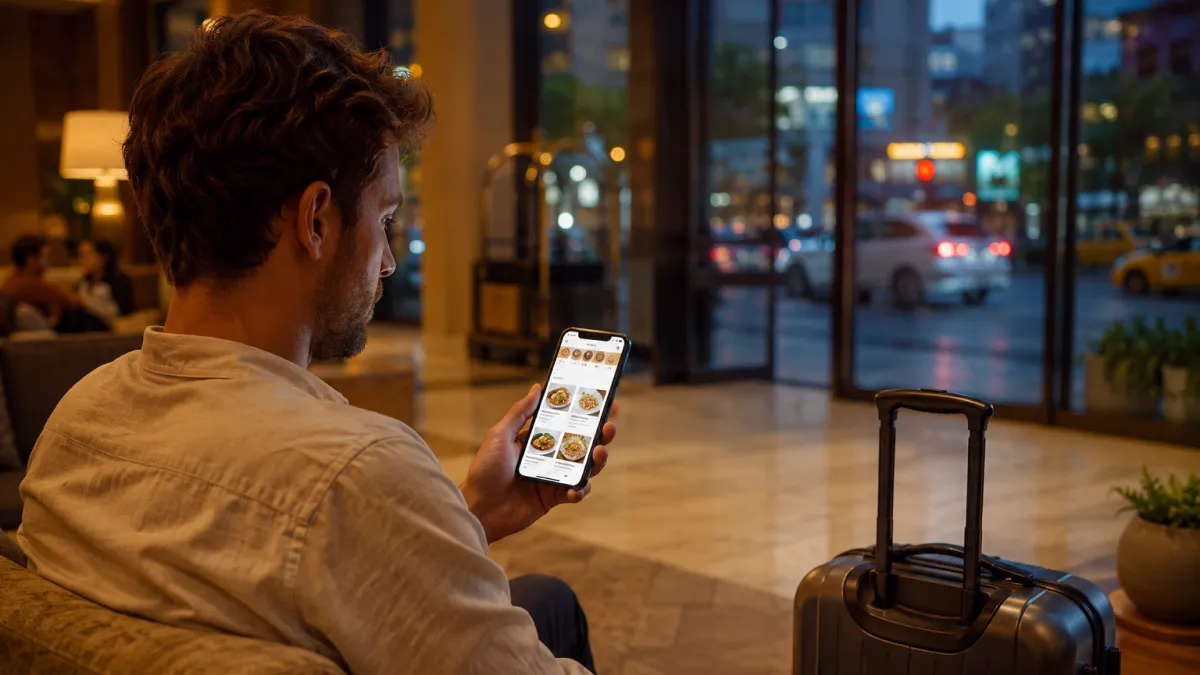
A QR menu is not automatically useful. If it opens a heavy PDF, forces guests to pinch and zoom, hides the language switcher, or loads slowly on hotel Wi-Fi, it may damage trust instead of building it.
Thailand is a mobile-ready market. DataReportal's Digital 2026 Thailand report lists 67.8 million internet users at the end of 2025, with 94.7% internet penetration, and 96.6 million cellular mobile connections. But mobile readiness does not excuse a bad mobile menu. Tourists may still be on roaming data, a weak beach connection, or an older phone.
Hospitality research on QR code menus also points to quality, not novelty. A 2026 International Journal of Hospitality Management study found that perceived information quality and interactive experience quality strongly affect QR code menu satisfaction and behavioral intention.
So the menu should be:
- fast to open;
- readable on a small screen;
- organized by clear categories;
- easy to switch languages;
- searchable or easy to scan visually;
- built with real text, not just images of menu pages;
- updated when prices, availability, or descriptions change.
The international customer should not feel that they are solving a technical problem before ordering dinner.
Use the same menu before, outside, and at the table
One underrated advantage of a multilingual QR menu is consistency.
The restaurant can use the same stable menu URL in several places:
- table tents;
- window signs;
- hotel partner messages;
- social media profiles;
- booking confirmations;
- Google Business Profile links;
- staff replies to guest questions.
When the URL stays stable, the restaurant can update the menu behind it without reprinting every QR code or sending a new link to every partner.
This matters for international customers because they often plan around uncertainty. A guest can check the menu from the hotel, decide there is something they can eat, and then scan the same QR code at the table.
In iMango, this is the practical workflow: create the menu once, add translations and photos where they matter, keep the QR destination stable, and edit the live menu when prices, items, availability, or wording change.
Help staff, do not replace hospitality
A multilingual QR menu should make service easier, not colder.
International guests still appreciate a welcome, a recommendation, and a human answer when needed. The menu simply removes repetitive friction.
Before:
"What is this? Is it spicy? Does it have pork? Can I choose shrimp? What is the sauce?"
After:
"I saw the green curry can be mild. Which protein do you recommend?"
That is a better conversation for both sides. The staff member can sell, guide, and host instead of translating the same basic fields all night.
Keep a paper fallback for guests who prefer it. A good QR menu should feel like an option that improves access, not a barrier that guests must pass to eat.
A practical checklist for attracting international customers
Use this checklist before promoting a multilingual QR menu publicly.
| Area | Minimum standard |
|---|---|
| Languages | Thai and English complete; add other languages based on real guest demand |
| QR placement | Visible on tables, window, counter, and relevant printed material |
| QR copy | Says "menu, photos, and translations", not only "scan me" |
| Mobile UX | Opens quickly, no app download, no PDF pinch-zoom |
| Language switcher | Easy to find before the guest reads the menu |
| Dish names | Local names preserved where useful, with plain descriptions |
| Photos | Clear images for signature, unfamiliar, and premium items |
| Allergens | Reviewed manually, especially nuts, shellfish, dairy, gluten, pork, alcohol, and fish sauce |
| Options | Translated add-ons, sizes, proteins, spice levels, and toppings |
| Updates | Prices, sold-out items, and seasonal menus kept current |
| Staff flow | Staff know the QR menu and can point guests to language support |
The goal is not to make the restaurant look more technical. The goal is to make the restaurant easier to choose.
Where iMango fits
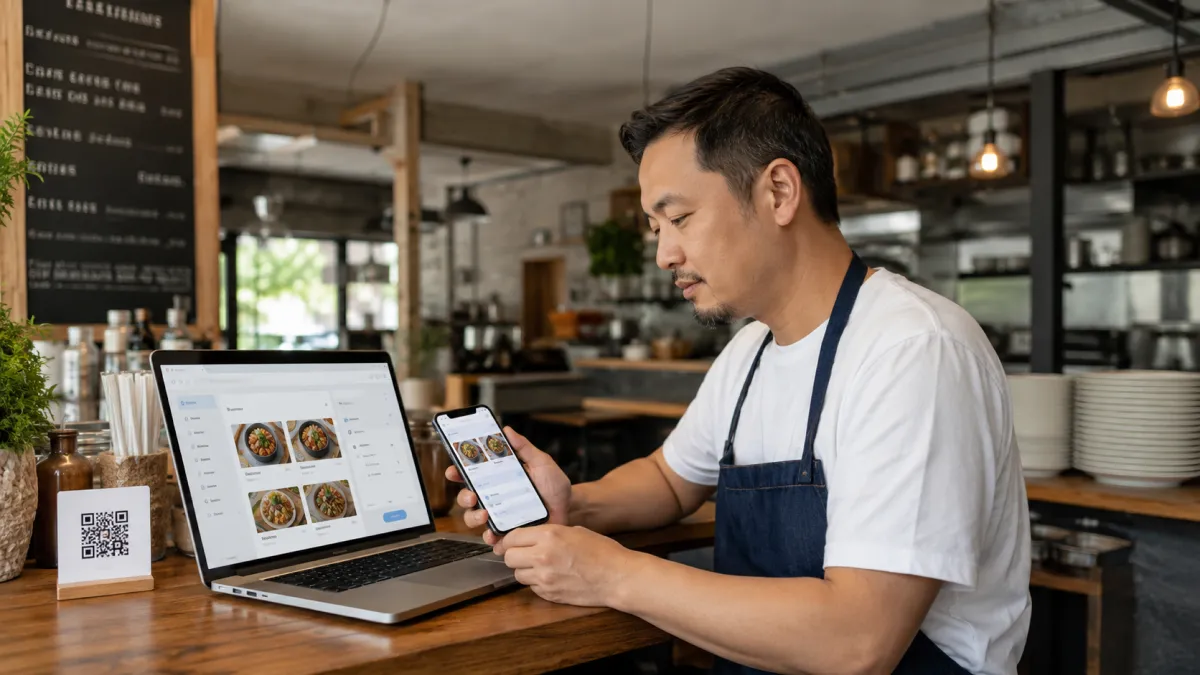
iMango is built for restaurants that want a mobile-first QR menu without turning menu maintenance into a software project.
For attracting international customers, that means:
- a stable public menu URL for QR codes and sharing;
- multilingual menu fields for supported restaurant languages;
- editable categories, items, descriptions, options, and photos;
- owner-controlled translation workflow;
- live updates without reprinting the QR code;
- a public menu that guests can open without downloading an app.
Use translation help as a draft, then review the menu like an operator. Signature dishes, allergens, dietary claims, spice levels, and premium items deserve a human check.
That is the difference between a translated menu and a restaurant that feels ready for international guests.
Try iMango free - create a mobile-first QR menu with translations, photos, and a stable public link for international customers.
Frequently Asked Questions
How does a multilingual QR menu attract international customers?
A multilingual QR menu attracts international customers by making the restaurant easier to evaluate and easier to use. Guests can check dishes, prices, photos, allergens, and language support before or during the visit, which reduces uncertainty and makes the restaurant feel more welcoming.
Is a multilingual QR menu better than a translated paper menu?
For tourist-heavy restaurants, a multilingual QR menu is usually easier to maintain than translated paper menus. Prices, photos, sold-out items, and translations can be updated without reprinting. A small paper fallback is still useful for guests who prefer it.
Which languages should restaurants add first?
Most restaurants in Thailand should start with Thai and English. Add other languages only when guest demand is visible in reviews, hotel traffic, staff questions, booking messages, or tourist source markets. iMango currently supports 15 restaurant menu content languages, with active public languages depending on the plan.
What menu content should be translated first?
Translate the fields that affect decisions first: category names, item names, short descriptions, option labels, spice levels, allergens, dietary notes, sold-out labels, and QR instructions.
Can AI translation handle a restaurant menu by itself?
AI translation can create a useful first draft, but restaurants should review high-impact wording before guests rely on it. Allergens, dietary claims, local dish names, spice levels, and premium dish descriptions need owner control.
Do food photos matter for international customers?
Yes. Photos help guests understand unfamiliar dishes faster, especially when the dish name is local or culturally specific. The best results come from combining clear photos with short translated descriptions.