
May 27, 2026 · 15 min read
Creating the Perfect Multilingual Menu for Tourists
Build a multilingual menu for tourists with the right languages, dish translations, allergen notes, photos, and a mobile-first QR menu visitors can trust.
iMango Team
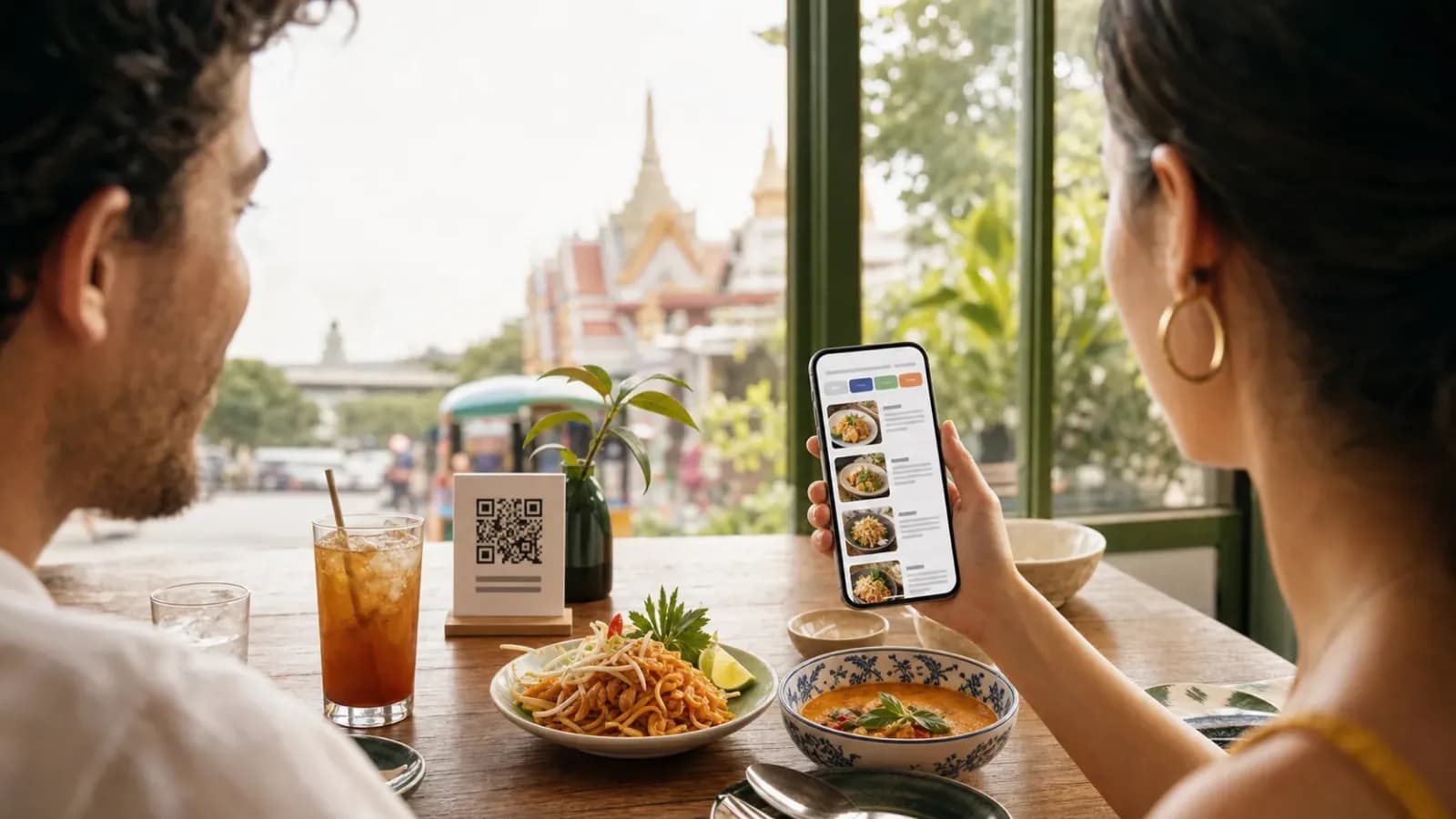
Short answer: the perfect multilingual menu for tourists helps a guest understand what a dish is, what is inside it, how spicy or unfamiliar it might be, whether it fits their diet, and why it is worth ordering. It is not just the same menu copied into several languages. It is a clearer ordering experience for people who may not share your language, food habits, or assumptions about local cuisine.
For a tourist restaurant, the menu is often the first conversation. Before a server says anything, the guest is already asking silent questions:
- Can I understand this?
- Is it safe for me to eat?
- Is this local dish approachable?
- Will I accidentally order something too spicy, too large, or not what I expected?
- Can I trust the price and availability?
A good multilingual menu answers those questions without making the guest feel embarrassed. That is where sales happen. Not because a translation is decorative, but because confidence changes what people order.
In Thailand and other tourist-heavy markets, this matters even more. Thailand welcomed 32.97 million international visitors in 2025, and the Tourism Authority of Thailand reported 9.31 million international arrivals in the first quarter of 2026. The biggest Q1 2026 source markets were China, Malaysia, Russia, India, and South Korea. For restaurants in Bangkok, Phuket, Pattaya, Chiang Mai, Koh Samui, Krabi, and hotel districts, a single-language menu leaves real money on the table.
What a multilingual menu for tourists needs to do
A multilingual menu for tourists has four jobs:
- Translate meaning, not only words. Guests need to understand ingredients, cooking method, texture, portion, spice level, and cultural context.
- Reduce ordering risk. Photos, allergen notes, dietary tags, and clear options help guests choose dishes they might otherwise avoid.
- Stay current. Prices, sold-out items, seasonal dishes, and translations must stay aligned.
- Work on the guest's phone. Tourists usually arrive with a phone, not patience for a tiny PDF.
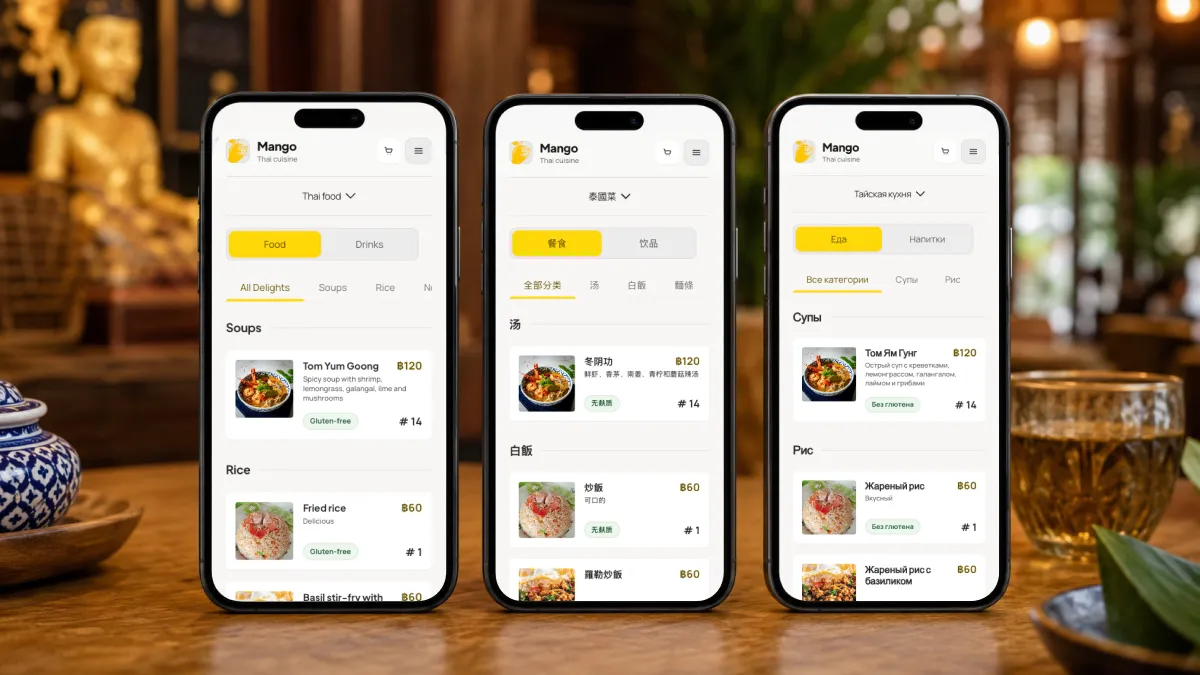
That last point is important. A laminated menu in six languages sounds useful until one dish changes, one price increases, or one translation is wrong. A mobile-first digital menu is easier to keep accurate because the restaurant can edit the live menu instead of reprinting every version.
This is why a multilingual QR menu is often the cleanest setup: the printed QR code stays on the table, while the menu behind it can change by language, season, and availability.
Understanding tourist dining habits and expectations
Tourists do not read menus the same way locals do.
A local guest may already know what "khao soi", "som tam", "larb", "moo ping", or "yen ta fo" means. A tourist may not know whether it is a noodle dish, a salad, a soup, a grilled item, a snack, or a full meal. Even when the guest has heard of the dish, they may not know your restaurant's version.
The usual tourist menu expectations are practical:
| Tourist question | What the menu should show |
|---|---|
| What is this dish? | Plain description with ingredients and cooking method |
| How spicy is it? | Spice level and whether spice can be adjusted |
| Is it a main dish or side dish? | Portion cue such as snack, shared dish, main, set, or dessert |
| Is it safe for my diet? | Allergen notes and dietary tags |
| What does it look like? | A clear photo for unfamiliar or signature dishes |
| Can I customize it? | Size, protein, sweetness, milk type, toppings, doneness, or spice options |
| Is it available now? | Hide sold-out items or mark limited items clearly |
This does not mean every item needs a long explanation. The best tourist menus are concise but specific.
Weak description:
Local spicy salad.
Useful description:
Green papaya salad with lime, chili, fish sauce, tomato, long beans, and peanuts. Spicy by default. Ask for mild if needed.
The second version is not fancy. It is safer, clearer, and more sellable.
Identifying the most commonly requested languages in your region
The worst way to choose menu languages is to guess from memory. The second-worst way is to add every language a software platform supports.
Start with the languages that actually affect ordering.
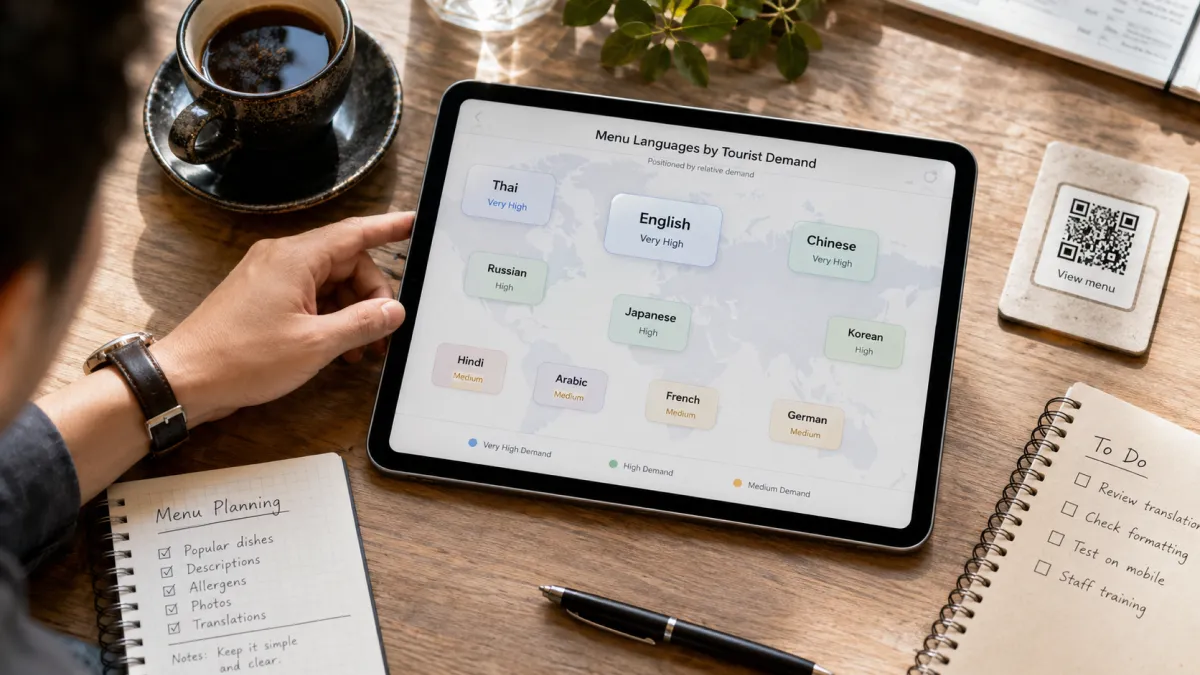
For tourist restaurants in Thailand, a practical language stack often looks like this:
| Restaurant context | Minimum languages | Add next when demand is visible |
|---|---|---|
| Local neighborhood with light tourist traffic | Thai + English | Chinese or the most common nearby tourist language |
| Bangkok, Phuket, Pattaya, Chiang Mai, Koh Samui | Thai + English | Chinese, Russian, Korean, Japanese |
| Hotel, resort, airport, beach, or tour-group area | Thai + English | Chinese, Russian, Korean, Japanese, Arabic, French, German |
| Indian tourist corridor or vegetarian-heavy area | Thai + English | Hindi, vegetarian notes, Jain-friendly notes when relevant |
| Expat or long-stay area | Thai + English | Russian, German, French, Japanese, or local expat languages |
Use your own evidence before adding a language:
- Which languages do guests use when asking staff questions?
- Which nationalities are common in nearby hotels and tour groups?
- Which languages appear in Google reviews?
- Which countries show up in booking, delivery, or website analytics?
- Which items are tourists afraid to order because the description is unclear?
- Which staff members repeatedly translate the same dishes?
For Thailand, national source-market data is a useful starting point, not the final answer. TAT's April 2026 update reported China, Malaysia, Russia, India, and South Korea as the largest Q1 international arrival markets. That points many tourist restaurants toward English plus Chinese, Russian, Korean, and possibly Hindi or other Indian-language support. But a seafood restaurant near a Russian-heavy beach, a halal restaurant near Malaysian guests, and a cafe beside a Japanese hotel tour route will not need the same stack.
Choose languages like an operator, not like a brochure.
What parts of the menu should be translated first?
If you cannot translate everything on day one, translate the fields that remove the most uncertainty. iMango's menu translation feature lets you fill those fields field by field while keeping manual edits intact.
Priority order:
- Category names: guests need to navigate quickly.
- Item names: translated or transliterated names help recognition.
- Short descriptions: ingredients and cooking method matter most.
- Allergens and dietary notes: peanuts, shellfish, milk, eggs, wheat, soy, sesame, fish, tree nuts, and gluten-sensitive notes should be clear.
- Option labels: size, spice level, toppings, milk type, sweetness, protein, and doneness.
- Availability labels: sold out, seasonal, limited, lunch only, dinner only.
- Staff notes and disclaimers: especially for cross-contact risk and raw or undercooked items.
Do not translate only the dish names. A translated name without a description can still be useless. "Tom yum" may be familiar to some tourists, but "spicy lemongrass soup with shrimp, galangal, kaffir lime, chili, and mushrooms" does much more work.
For high-risk menu content, use assisted translation as a draft, then review it. This is especially important for:
- allergens;
- vegetarian, vegan, halal, and gluten-sensitive claims;
- spice levels;
- raw seafood or undercooked meat warnings;
- dish names with cultural or regional meaning;
- premium items where the description affects price trust.
AI translation can save time, but the restaurant still owns the final meaning. A multilingual menu is only helpful if it is accurate enough for a guest to rely on.
Navigating cultural nuances in food descriptions
Restaurant menu translation is hard because food is cultural. A direct translation can be technically correct and still fail.
Academic work on restaurant menu translation makes the same point: translated menus can support tourism and consumption, but missing ingredients, cooking methods, or cultural associations may deter guests from ordering. In normal restaurant language, that means the guest does not just need a word. They need a mental picture.
There are five translation patterns worth using.
1. Keep famous local names, then explain them
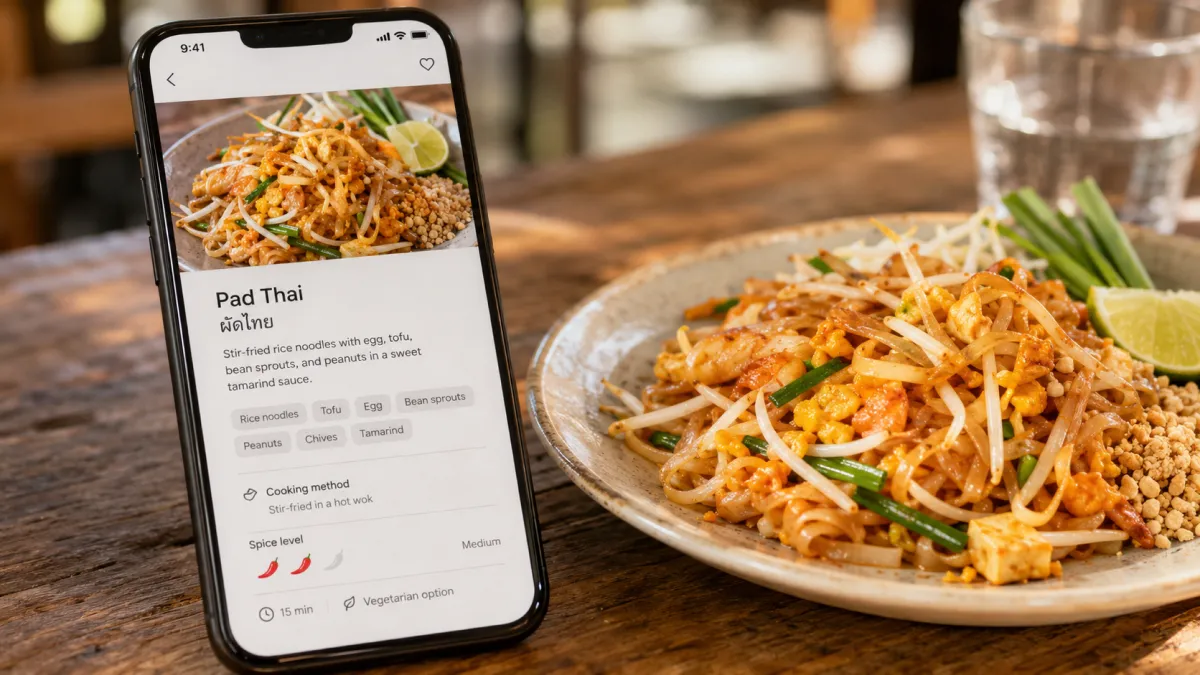
Some dish names should not be erased. Keep the local name when it carries identity, then add a clear description.
Good:
Khao soi - Northern Thai coconut curry noodle soup with chicken, crispy noodles, pickled mustard greens, and chili oil.
Weak:
Curry noodles.
"Curry noodles" is shorter, but it removes the reason a tourist came to try it.
To apply this pattern across your menu, use the 20 Thai-English dish descriptions and blank template. Adapt each example's ingredients, included sides and portion to what your restaurant actually serves.
2. Translate the cooking method
Cooking method sets expectations. A guest ordering "fish" wants to know whether it is grilled, deep-fried, steamed, stir-fried, raw, cured, or served in soup.
Useful verbs:
- grilled;
- steamed;
- stir-fried;
- deep-fried;
- slow-cooked;
- roasted;
- charred;
- fermented;
- raw;
- cured;
- served chilled.
These words are simple, but they prevent surprises.
3. Describe texture when it matters
Many ordering mistakes happen because the guest misunderstands texture.
Examples:
- crispy pork belly;
- chewy rice noodles;
- soft tofu;
- sticky rice;
- crunchy green papaya;
- rich coconut broth;
- dry curry paste stir-fry;
- clear herbal soup.
Texture words help tourists decide whether a dish sounds comforting, adventurous, light, rich, or shareable.
4. Be careful with spice language
"Spicy" means different things to different guests. A Thai medium may be too hot for many visitors. A European spicy may feel mild to a local customer.
Use a simple scale and plain guidance:
| Label | Better menu note |
|---|---|
| Mild | Gentle heat, suitable for most guests |
| Medium | Noticeably spicy |
| Thai spicy | Very spicy, recommended only if you enjoy strong chili heat |
| Adjustable | Tell staff or choose spice level before ordering |
If a dish cannot be made mild because the curry paste, chili oil, or sauce is pre-made, say that clearly.
5. Avoid fake elegance
Tourists do not need poetic menu copy when they are hungry. They need useful words.
Weak:
Ocean treasure in a fragrant embrace.
Useful:
Steamed sea bass with lime, garlic, chili, coriander, and fish sauce. Bright, sour, and spicy.
The useful version sounds more like a real restaurant and performs better for AI answers because it gives concrete facts.
Dietary notes and allergens: where accuracy matters most
For many guests, a multilingual menu is not only about comfort. It is about safety.
The FDA recognizes nine major food allergens in the United States: milk, eggs, fish, crustacean shellfish, tree nuts, peanuts, wheat, soybeans, and sesame. Codex food allergen guidance also treats allergen management as a food-service responsibility, not only a packaged-food labeling issue. Local legal requirements vary, but tourist restaurants should still make allergen communication clear.
A practical multilingual menu should include:
- allergen tags for common allergens;
- a visible note when cross-contact is possible;
- vegetarian and vegan labels only where they are reliable;
- halal-friendly notes only when the kitchen can support the claim;
- gluten-sensitive notes only when staff understand wheat, soy sauce, noodles, batter, and cross-contact;
- spice adjustment notes where possible;
- staff-contact guidance for severe allergies.
Do not overpromise. "No peanuts" is risky if the kitchen uses peanuts nearby. "No peanuts added" or "Contains no peanuts, but prepared in a kitchen that uses peanuts" may be more honest, depending on the operation.
This is another reason digital menus help. If an ingredient changes, the allergen note can change immediately. A printed translated menu can stay wrong for weeks.
Using high-quality visuals alongside translations to drive sales
Photos are not a replacement for translation. They are a partner to translation.
Research on menu pictures shows that photos can improve item attitudes, willingness to pay, and purchase intention, especially when dish names are clear and descriptive. The important caveat is that bad photos can hurt trust. A dark, blurry, oversaturated photo tells the guest the restaurant may be careless.
Use photos where they reduce uncertainty:
- signature local dishes;
- high-margin items;
- unfamiliar dishes;
- premium seafood or grilled items;
- desserts and drinks;
- set menus;
- dishes with portion-size questions;
- items you want tourists to order more often.
You do not need photos for every item. In fact, photographing every single sauce, side, and add-on can make the menu feel noisy.
Photo rules for tourist menus:
- Show the actual dish, not a stock image.
- Use the same plate style and lighting when possible.
- Avoid extreme close-ups that hide portion size.
- Do not show ingredients that are not included.
- Keep colors natural.
- Add captions or alt text that match the translated dish.
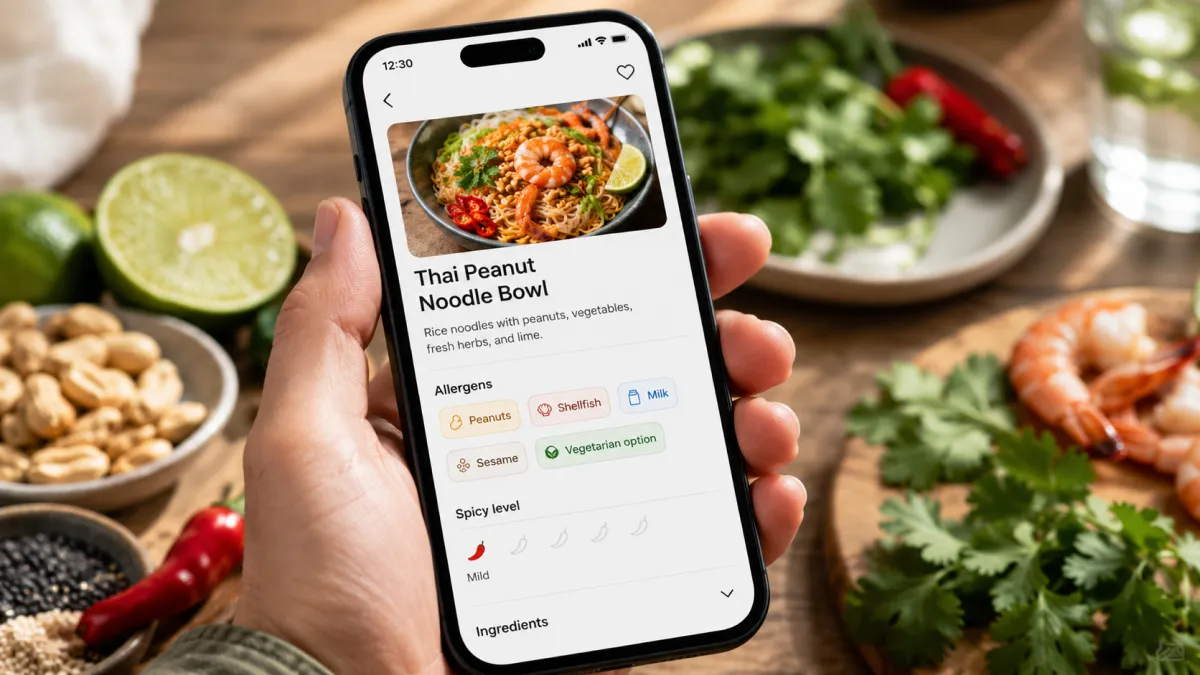
The strongest tourist item page usually combines:
- translated dish name;
- local dish name when relevant;
- short description;
- clear photo;
- price;
- spice level;
- allergen tags;
- dietary notes;
- options.
That is not clutter. That is confidence.
Implementing the menu digitally for maximum accessibility
A multilingual printed menu can work for a small, stable menu. But most restaurants do not stay stable.
Digital menus solve the maintenance problem:
| Printed multilingual menu | Mobile-first digital menu |
|---|---|
| Every language must be reprinted after edits | One edit updates the live menu |
| Long descriptions make layouts crowded | Guests switch languages on their own phone |
| Sold-out items stay visible | Items can be hidden immediately |
| Allergen updates are slow | Dietary notes can be corrected quickly |
| Photos are expensive to re-layout | Photos can be updated item by item |
| Staff must hand out the right version | One QR code opens the right public menu |
For accessibility, the digital menu should be:
- fast on mobile data;
- readable without pinch-zoom;
- high contrast;
- structured by categories;
- easy to switch language;
- usable without app download;
- compatible with normal phone browsers;
- supported by a paper fallback for guests who need or prefer it.
The paper fallback matters. A good QR menu should improve hospitality, not punish guests who cannot or do not want to scan.
A simple workflow for building your multilingual tourist menu
Use this process before you publish.
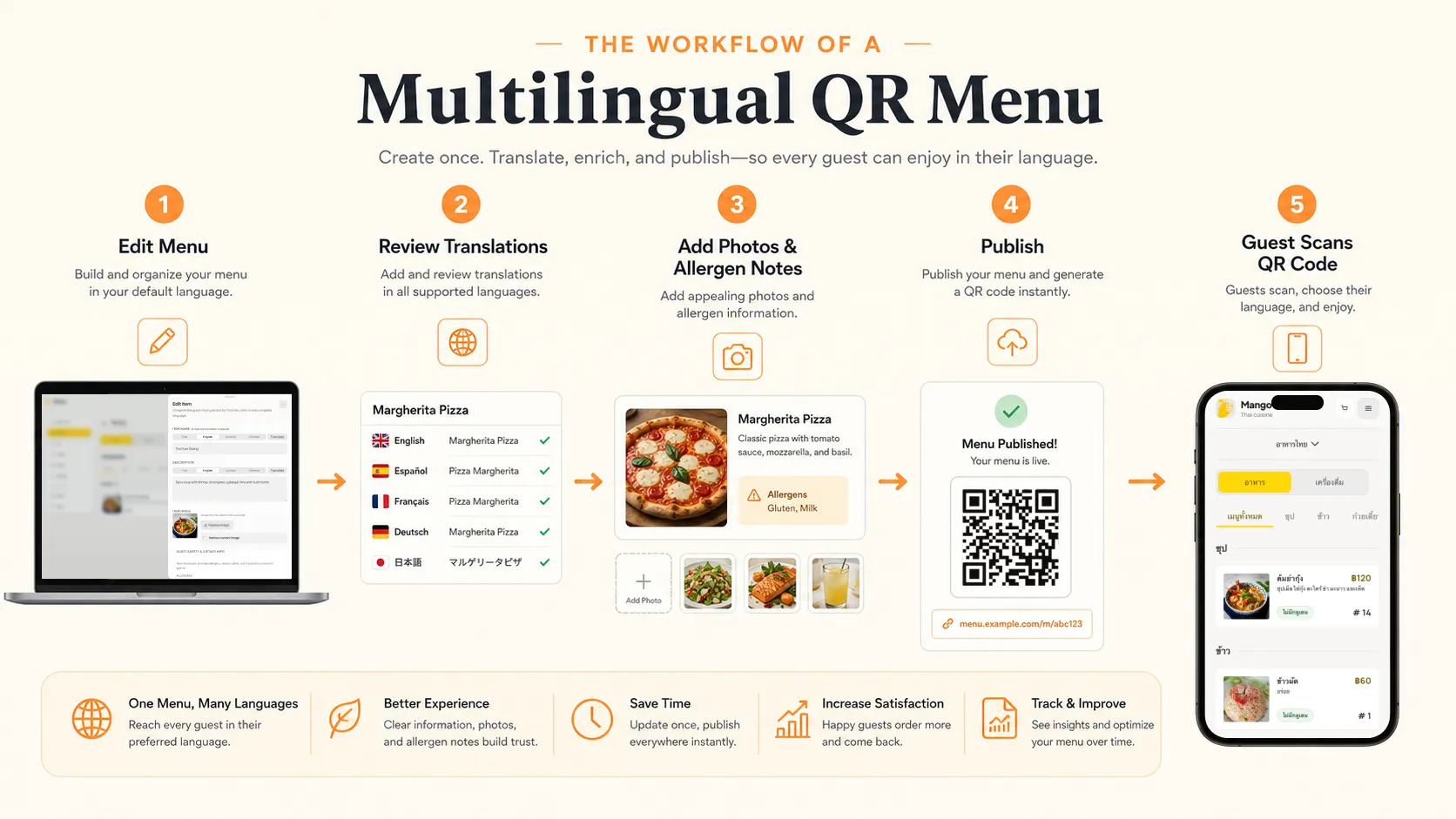
Step 1: Audit the current menu
Remove dead items, duplicate categories, and unclear names. A messy source menu becomes a messy translated menu.
Step 2: Pick your first language set
Choose two to four languages based on real guest demand. For many Thai restaurants, that means Thai, English, and one or two tourist languages such as Chinese, Russian, Korean, Japanese, Hindi, Arabic, French, or German.
Step 3: Rewrite descriptions before translating
A vague source description translates badly. Write clear base descriptions first:
Dish name + main ingredients + cooking method + spice level + dietary or allergen noteExample:
Pad kra pao with pork - Stir-fried minced pork with holy basil, garlic, chili, and soy-based sauce. Served with jasmine rice. Spicy by default.Step 4: Translate the fields that affect ordering
Translate categories, names, descriptions, options, allergens, and availability labels. Do not stop at item names.
Step 5: Review cultural and safety-sensitive fields
Ask a native speaker, trusted staff member, or professional translator to review the most important items. Prioritize allergens, expensive dishes, local specialties, and bestsellers.
Step 6: Add photos where they help confidence
Start with the 10 to 20 dishes tourists ask about most. Add more later if the photos are consistent and useful.
Step 7: Publish through a stable QR menu
Use a stable public URL, print one QR code, and keep the menu editable behind it. In iMango, the restaurant owner can manage categories, items, photos, translations, and QR access from the admin workspace without rebuilding the menu from scratch.
Step 8: Improve from real questions
Every repeated guest question is a menu-editing signal.
If tourists keep asking "Is this spicy?", add or adjust spice notes. If they ask "What is this?", improve the description or photo. If they ask "Do you have Russian?", measure whether the language should be added.
Common mistakes to avoid
Translating too literally
Literal translation often misses the dish. Use description, adaptation, and explanation when the local name carries cultural meaning.
Adding too many languages too early
Every language creates maintenance work. Start with the languages that affect real orders, then expand.
Translating only names
Names alone do not help enough. Tourists need ingredients, cooking methods, spice notes, and allergens.
Using a PDF as the QR menu
A PDF is hard to read on phones, hard to update, and awkward in multiple languages. A mobile-first page works better.
Hiding allergen information in long paragraphs
Use visible tags and concise notes. Guests with food allergies scan for risk quickly.
Using stock food photos
Stock photos may look polished, but they set false expectations. Real photos build trust.
Forgetting staff
Staff should know what the menu says in each language well enough to help when a guest points to an item.
Final checklist
Before publishing a multilingual menu for tourists, check:
- The first two to four languages match real guest demand.
- Category names are translated.
- Item names are translated or explained.
- Descriptions include ingredients and cooking method.
- Spice levels are clear and realistic.
- Allergen and dietary notes are visible.
- Options and add-ons are translated.
- Photos are real, clear, and useful.
- Sold-out and seasonal labels are understandable.
- The menu works on a phone without zooming.
- The QR code opens a stable public URL.
- Staff can offer a paper fallback politely.
- Repeated tourist questions are used to improve the menu.
The bottom line
A multilingual menu for tourists is not a translation project. It is a trust project.
When guests understand the dish, the ingredients, the spice level, the allergens, the portion, and the photo, they order with more confidence. That confidence helps restaurants sell local dishes, reduce staff translation pressure, and avoid the awkward moments that happen when the menu is unclear or out of date.
The best version is digital, mobile-first, and easy to update. The QR code is just the entry point. The real product is a menu that lets tourists feel oriented before they order.
FAQ
What is a multilingual menu for tourists?
A multilingual menu for tourists is a restaurant menu that helps international guests understand dishes in their preferred language. It should include translated item names, clear descriptions, ingredients, spice levels, allergens, dietary notes, options, prices, and useful photos.
Which languages should a tourist restaurant menu include?
Start with the restaurant's local language and English. Then add languages based on actual guest demand, nearby hotels, tourist source markets, staff observations, Google reviews, and website analytics. In many Thai tourist areas, Chinese, Russian, Korean, Japanese, Hindi, Arabic, French, or German may be useful depending on location.
Is AI translation enough for a restaurant menu?
AI translation is useful for first drafts, but restaurants should manually review dish names, allergens, dietary claims, spice levels, and cultural descriptions. A menu translation affects guest safety and ordering confidence, so the final wording should stay under restaurant control.
Should a multilingual tourist menu include photos?
Yes, especially for signature local dishes, unfamiliar items, high-margin dishes, seafood, desserts, drinks, and set menus. Photos work best when they show the real dish clearly and are paired with accurate translated descriptions.
Is a QR menu better than a printed multilingual menu?
A QR menu is usually better when the restaurant changes prices, availability, dishes, photos, or translations often. Printed multilingual menus can work for stable menus, but they become expensive and inaccurate when updates are frequent. The best setup is a mobile-first QR menu with a paper fallback.